

On this page+
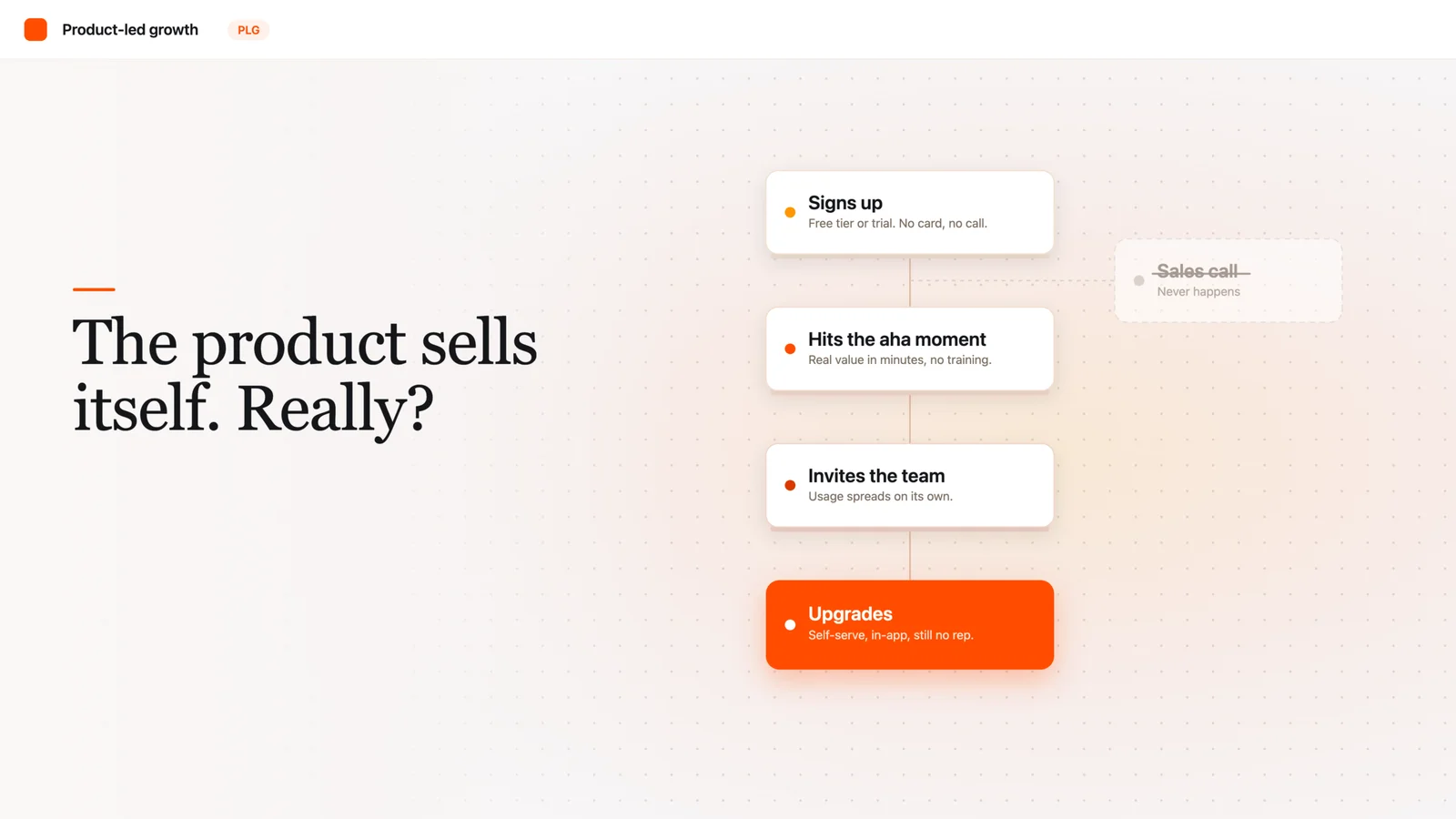
Product-led growth (PLG) is a go-to-market strategy where your product itself, not a salesperson or an ad campaign, does the work of getting people to try, adopt, and pay for what you sell. Users experience value firsthand, often through a free trial or freemium version, before anyone in sales ever talks to them.
If you’ve ever signed up for a tool, poked around for ten minutes, and started using it without a single call with a rep, you’ve already lived through PLG. It’s not a buzzword invented to sound fancy. It’s a real shift in how software companies grow, and it’s worth understanding even if you’re not planning to rebuild your GTM (go-to-market, meaning how a company brings a product to customers) motion around it tomorrow.
What Is Product-Led Growth, Exactly?
At its core, product-led growth is a business strategy that relies on product usage as the main way to acquire, engage, and retain customers, rather than leaning on a sales team to do the convincing. Instead of a rep walking a prospect through slides and a demo, the prospect just opens the product and figures out the value themselves.
The term didn’t come out of nowhere. It was originally coined in 2016 by Blake Bartlett at OpenView, a venture capital firm, although the underlying tactics had already been floating around software companies before that. Companies were experimenting with freemium models (a free, limited version of the product) and self-guided product tours to grow while staying profitable, which used to be seen as a tradeoff you couldn’t avoid.
Here’s the plain version: instead of hiring more salespeople to close more deals, you invest in making the product so good that it sells itself, or at least does most of the early legwork.
How Is PLG Different From Sales-Led Growth?
Sales-led growth (SLG) is the model most people picture when they think of enterprise software: a rep reaches out, books a demo, negotiates a contract, and eventually closes a deal. This approach tends to work well for complex products that need customization, hands-on onboarding, or in-depth explanation, which is part of why companies like Salesforce and Oracle still lean heavily on it.
PLG flips that. Customers can purchase solutions and complete onboarding without ever coming into contact with a salesperson, because the product is built to explain and prove its own value. Companies like Slack, Shopify, and Zoom are frequently pointed to as strong examples of this in action.
Neither model is objectively “better.” Honestly, most companies that claim to be pure PLG or pure sales-led are oversimplifying. A lot of successful B2B companies end up blending both: a self-serve product that lets small teams get started free, with a sales team that steps in once an account starts looking like a bigger opportunity.
Why Does PLG Matter for B2B Founders?
A few reasons founders and revenue leaders keep paying attention to this model:
It can lower your cost of acquiring customers. PLG typically reduces sales friction and can lead to shorter sales cycles, lower customer acquisition costs, and higher revenue per employee, since the product is doing work that would otherwise require a headcount-heavy sales org.
It scales without scaling headcount at the same rate. As a company grows, a 1:1 human-to-human support and sales model becomes harder to sustain, and PLG helps by automating onboarding, support, and parts of the sales motion so people can focus on more strategic work.
The adoption numbers back this up too. According to one industry benchmarks report, almost 60% of surveyed SaaS companies had already implemented a product-led growth motion. And on the cost side, PLG companies report a median CAC (customer acquisition cost) payback period of about 15 months, compared to 29 months for sales-led companies, according to OpenView Partners research.
That’s not a small gap. If you’re spending money to acquire customers, cutting your payback period nearly in half is the kind of thing that changes your whole financial picture.
What Does PLG Actually Look Like Day to Day?
It’s easier to picture with real examples. Companies such as Atlassian, Calendly, and Pinterest have used PLG to drive ongoing growth and customer loyalty, largely by getting users to a meaningful “aha moment” fast, without a sales conversation getting in the way.
A simple example: someone signs up for a free trial of a project management tool on a Tuesday afternoon, invites two coworkers by Wednesday, and by the following week their whole team is using it daily. Nobody from sales called them. The product convinced them, and then their own usage convinced their teammates.
How Do You Know If PLG Might Be Right for You?
Before you decide PLG is (or isn’t) for your company, run through this quick checklist:
- Can a new user get real value from your product within minutes, without training? If it takes a two-hour onboarding call just to see the point, PLG will be an uphill climb.
- Is your product simple enough to try without heavy customization or implementation work?
- Can you offer a free trial or freemium tier without giving away your entire business model?
- Do your product, marketing, and support teams talk to each other regularly, or do they operate in silos? PLG needs cross-functional alignment to work.
- Are you set up to track in-product usage data, not just website visits and form fills?
Pro tip: don’t try to flip a switch from fully sales-led to fully product-led overnight. Start by adding a free trial or limited free tier to one product line, watch how people actually use it, and build your sales process around what the data tells you, not the other way around.
What Is a PQL, and Why Does It Come Up in PLG Conversations?
Once you’re running a PLG motion, you’ll start hearing the term PQL, or product qualified lead. A product qualified lead is a user whose in-product behavior signals they’re ready to become a paying customer, as opposed to someone who just downloaded a whitepaper or filled out a form.
Frequently asked
Is product-led growth only for SaaS companies?
Most of the well-known examples are SaaS, since software makes it easy to offer free trials and track usage data. But the underlying idea (let the product prove its value before you ask for money) can apply more broadly, it’s just harder to pull off outside software.
Does PLG mean I don’t need a sales team?
No. PLG is not a substitute for human support and sales, it’s a complement to it. Most companies running PLG still have a sales team, they just focus that team on the accounts and moments where a human conversation actually adds value.
What’s the biggest mistake companies make when trying PLG?
Treating it as a marketing tactic instead of a company-wide strategy. If your product, support, and sales teams aren’t aligned on what a good user experience looks like, a free trial alone won’t save you.
How long does it take to see results from a PLG motion?
There’s no universal timeline, and honestly anyone who gives you an exact number is guessing. It depends on how fast users reach real value in your product and how quickly your team can turn usage data into a working PQL definition.
Can a company be both sales-led and product-led?
Yes, and many successful B2B companies are. A self-serve free tier paired with a sales team for larger accounts is a common and practical setup.

CEO & Founder at Revlyn. Part of the team that builds and operates HubSpot portals day to day.