

On this page+
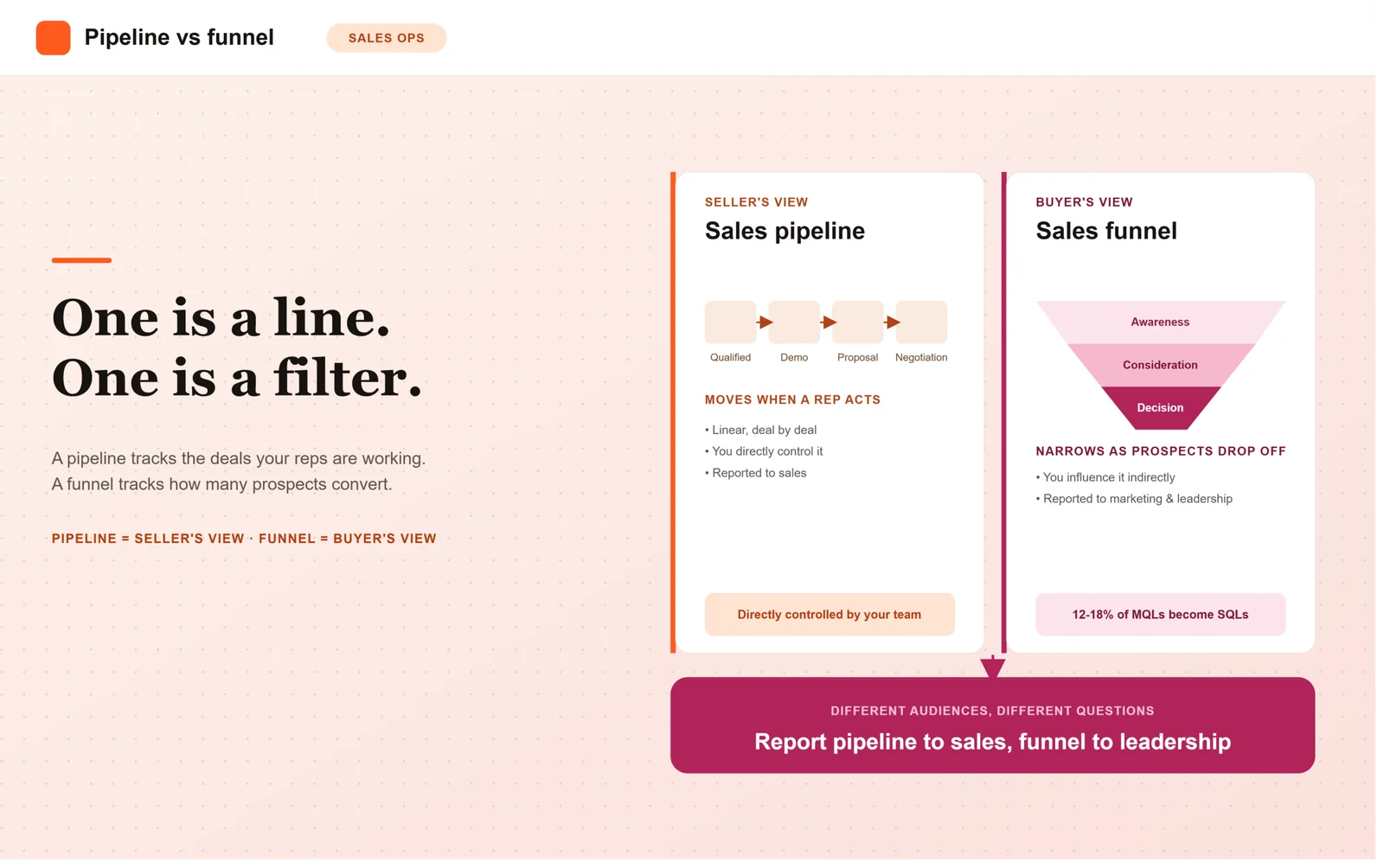
A sales pipeline tracks the specific deals your sales team is working and the actions reps take to move each one forward. A sales funnel tracks the broader flow of prospects and measures what percentage convert at each stage of the buyer’s journey. One is about your team’s activity; the other is about volume and conversion rates.
If you’ve ever sat in a pipeline review and someone said “pipeline” when they meant “funnel” (or vice versa), you’re not alone. The two terms get used interchangeably all the time, even by people who’ve been in sales for years.
But they’re not the same thing, and mixing them up can cost you. If you’re reporting funnel conversion numbers when your VP actually wants pipeline health, you’re going to have an awkward meeting.
What is a sales pipeline?
A sales pipeline is your sales team’s internal view of every active deal, organized by stage. Think of it as a dashboard showing exactly where each opportunity stands in your sales process, from first contact to closed won or closed lost.
Each deal in your pipeline sits in a stage like “Qualified,” “Demo Scheduled,” “Proposal Sent,” or “Negotiation.” A sales pipeline outlines the steps that a sales team takes to turn prospects into paying customers, and it’s built around internal processes and actions, not the buyer’s mindset.
That’s an important distinction. A pipeline stage moves forward because a rep did something (sent a proposal, booked a demo) or because the buyer took a specific, observable action, not because someone “felt good” about the call.
What is a sales funnel?
A sales funnel is a visual representation of your potential customers moving through various stages in their decision-making process, from the moment they become aware of your product to the moment they buy.
While pipeline stages track individual deals, the funnel is volume-focused. It shows how your potential customer base narrows down as people drop off at each stage. Picture 1,000 leads entering at the top; by the time you get to signed contracts, you might have 8. That drop-off, stage by stage, is exactly what the funnel shows.
Most funnels follow a simple structure: awareness, consideration, and decision, though many teams add more granular stages depending on their sales motion.
Sales pipeline vs. sales funnel: what’s actually different?
Here’s the plain version. The pipeline focuses on the specific actions and stages a salesperson takes to move a deal forward (what the seller does), while the funnel represents the journey from the customer’s point of view, measuring conversion rates at each stage (what the buyer does).
A few more ways to think about it:
- Perspective: Pipeline = seller’s view. Funnel = buyer’s view.
- Focus: Pipeline = individual deals and rep activity. Funnel = aggregate volume and conversion rates.
- Shape: A pipeline is roughly linear (deals move stage to stage). A funnel narrows, because most leads drop off before they buy.
- What you control: You can directly change your pipeline by adding or modifying sales tasks, but you can only influence your funnel indirectly, by improving lead quality and rep effectiveness.
Honestly, most teams that struggle with forecasting aren’t struggling because they lack data. They’re struggling because they’re tracking pipeline activity but reporting it as if it tells them funnel-level conversion truth, and those are two different questions.
Why does this distinction actually matter?
It’s not just semantics. Pipeline data and funnel data answer different questions, and if you use the wrong one, you’ll draw the wrong conclusion.
Say your VP asks why revenue is down this quarter. If you only look at the pipeline, you might see plenty of deals sitting in “Proposal Sent” and assume things are fine. But if you look at the funnel, you might notice conversion from lead to qualified opportunity has quietly dropped 30% over two months. That’s a top-of-funnel lead quality problem, not a closing problem, and you’d never catch it by staring at deal stages alone.
This is also where the MQL-to-SQL handoff tends to break down. The biggest drop-off typically happens at the marketing-qualified-lead to sales-qualified-lead stage, where only 12 to 18% of MQLs actually become SQLs. If you’re not tracking that conversion rate specifically (a funnel metric), you won’t see the leak until it shows up as a pipeline shortage weeks later.
Getting your pipeline stages right in the first place also feeds directly into forecasting accuracy, which is a topic we cover in more depth in our beginner’s guide to sales forecasting. And once your pipeline is clean, it’s worth checking whether you actually have enough of it. That’s where a pipeline coverage ratio comes in.
How to use both without confusing your team
Here’s a simple checklist for keeping the two straight:
- Name your pipeline stages around buyer actions, not seller effort. “Demo completed” is a better stage than “followed up.”
- Track funnel conversion rates separately from pipeline volume. Know your lead-to-MQL rate and MQL-to-SQL rate as distinct numbers.
- Report pipeline health to sales; report funnel conversion to marketing and leadership. Different audiences, different questions.
- Review both weekly. A healthy pipeline with a shrinking funnel is a warning sign your future pipeline is about to dry up.
- Keep your CRM as the single source of truth for both, so stage definitions don’t drift between what marketing calls a “lead” and what sales calls a “prospect.”
Pro tip: if two people on your team can’t agree on what counts as an “opportunity” moving into the pipeline, fix that definition before you build any funnel or pipeline report. Every number downstream depends on it.
Frequently asked
Are sales pipeline and sales funnel the same thing?
No. They describe the same general process (turning a prospect into a customer) but from different angles: the pipeline is the seller’s view of deal stages, and the funnel is the buyer’s view of conversion volume.
Which one should I use for forecasting?
Your pipeline is the primary input for forecasting, since it tracks the dollar value and stage of every open deal. The funnel helps you sanity-check that forecast by showing whether enough new opportunities are entering the top to sustain it.
Can a small sales team skip the funnel and just track the pipeline?
You can, but you’ll be flying a bit blind on lead quality. Even a rough funnel view (how many leads turn into qualified opportunities) helps you catch problems before they hit your pipeline.
Do pipeline stages have to match funnel stages?
Not exactly. The stages can overlap, but the pipeline is about what the deal needs next, while the funnel is about how many prospects are dropping off between stages. Some teams map them side by side, and that’s fine as long as everyone knows which report answers which question.
What CRM feature actually shows the difference?
Most CRMs display pipeline as a deal-stage board or Kanban view, and funnel data as a conversion report or drop-off chart. If your CRM only shows one of these, you’re missing half the picture.

Part of the Revlyn team that builds and operates HubSpot portals day to day.