

On this page+
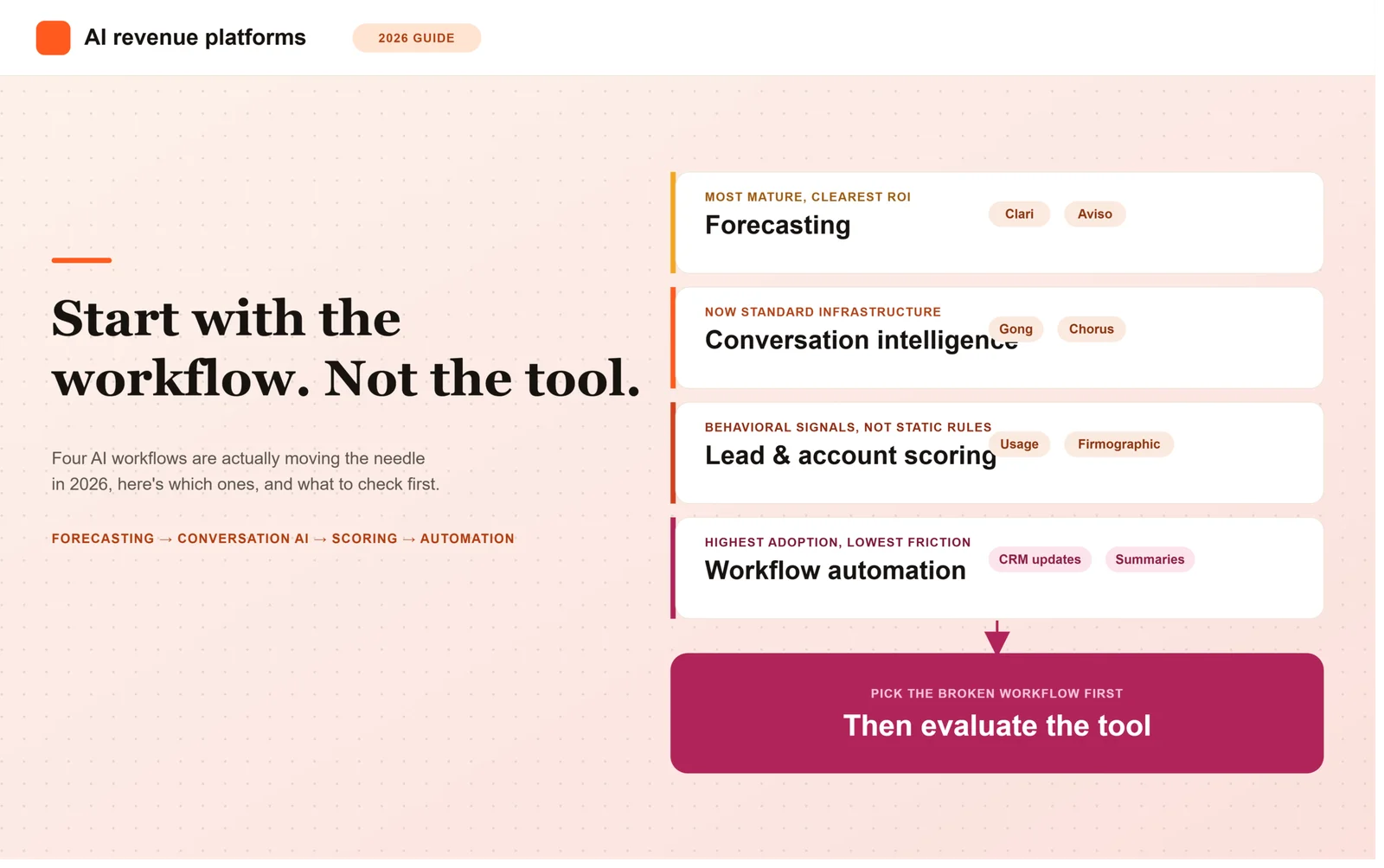
By 2026, the question for SaaS revenue teams isn’t whether to use AI. It’s which parts of the revenue workflow actually benefit from it, and which tools are worth paying for versus which are marketing dressed up as AI. This guide looks at the AI platforms genuinely changing how SaaS revenue teams forecast, prioritize, and sell, organized by the specific workflow each one improves.
Where AI Is Actually Delivering Value in Revenue Workflows
Not every part of the revenue process benefits equally from AI. The clearest wins in 2026 cluster around four workflows:
- Forecasting: predictive models that reduce reliance on rep-reported deal confidence
- Conversation intelligence: analyzing sales calls for risk signals, competitor mentions, and coaching opportunities
- Lead and account prioritization: scoring based on behavioral and firmographic signals rather than static rules
- Workflow automation: drafting follow-ups, updating CRM fields, and summarizing account activity automatically
Forecasting: Where AI Has Matured the Most
AI-driven forecasting tools (Clari, Aviso, and similar platforms) now pull signal from CRM activity, email and calendar engagement, and historical win-rate patterns to produce forecasts that are frequently more accurate than manager roll-ups based purely on rep judgment. For revenue leaders reporting to a board, this category delivers some of the clearest ROI of any AI investment in the stack.
Conversation Intelligence: From Nice-to-Have to Standard
Tools like Gong and Chorus have moved from “premium add-on” to close to standard infrastructure for any team running more than a handful of reps. The real value in 2026 isn’t just call recording. It’s automated risk flagging (competitor mentions, pricing objections, stalled momentum) surfaced directly into deal records without a manager having to listen to every call.
Lead and Account Scoring: Behavioral Signals Over Static Rules
Older lead scoring models relied on static point systems (job title +10, company size +5). AI-driven scoring now weighs actual behavioral patterns, such as which pages someone visited or how usage compares to accounts that historically converted or expanded, producing meaningfully better prioritization for both sales and customer success teams.
Workflow Automation: Time Given Back to Reps
AI-assisted CRM updates, meeting summaries, and follow-up drafting have quietly become one of the highest-adoption AI use cases, simply because they save reps hours per week on administrative work without requiring a change in how they sell.
Evaluation Framework for AI Revenue Platforms
| Criteria | What to Look For |
|---|---|
| Data foundation | Does it require clean CRM data to work, or can it function with messy inputs? |
| Explainability | Can it show why it made a prediction, not just the output? |
| Integration depth | Does it read and write back to your CRM natively, or require manual syncing? |
| Adoption friction | Does it change how reps work day-to-day, or fit into existing habits? |
| Proven ROI | Can the vendor show a measurable before/after from a comparable customer? |
Common Mistakes When Adopting AI Revenue Tools
- Buying a forecasting AI tool before CRM data hygiene is good enough for it to learn from
- Rolling out conversation intelligence without a clear coaching process to act on the insights
- Treating AI scoring as a replacement for, rather than an input to, sales judgment
- Adding tools faster than the team can actually adopt them into daily workflow
Start With the Workflow, Not the Tool
The SaaS teams getting the most value from AI in 2026 didn’t start by shopping for “an AI platform.” They started by identifying a specific workflow, such as forecast accuracy, call coaching, or lead prioritization, that was clearly broken, and then evaluated AI tools specifically against fixing that problem. Platform-first shopping tends to produce expensive tools that never get fully adopted.
Frequently asked
What’s the difference between an AI CRM feature and a standalone AI revenue platform?
AI CRM features are built directly into your existing CRM tier, handling basics like lead scoring or simple forecasting. Standalone AI revenue platforms (Clari, Gong, Chorus, and similar tools) sit alongside the CRM and go deeper into one specific workflow, like forecasting or conversation intelligence, usually with more accuracy and configurability than the CRM’s native version.
Do we need clean CRM data before adopting AI forecasting tools?
Yes. AI forecasting models learn from historical CRM activity and win-rate patterns, so messy or inconsistent data produces unreliable predictions. Most teams should prioritize basic data hygiene before investing in AI forecasting, or the tool will simply automate bad guesses faster.
Is conversation intelligence worth it for a small sales team?
It depends on team size and deal complexity. Conversation intelligence tends to deliver the most value once a team has enough reps and call volume that a manager can no longer realistically listen to every call. Very small teams may get more immediate value from forecasting or workflow automation tools first.
How is AI-driven lead scoring different from traditional lead scoring?
Traditional lead scoring uses static rules, such as fixed points for job title or company size. AI-driven scoring instead weighs actual behavioral signals, like page visits or product usage patterns, compared against accounts that historically converted or expanded, which typically produces more accurate prioritization.
What’s the biggest risk when adopting AI revenue tools too quickly?
Adopting tools faster than the team can actually integrate them into daily workflow. A forecasting tool, a conversation intelligence platform, and a scoring engine added all at once, without a clear process for acting on each one’s output, often leads to low adoption and wasted spend rather than better decisions.
Should AI scoring replace sales judgment entirely?
No. AI scoring works best as an input to sales judgment, not a replacement for it. Reps and managers still bring context that behavioral and firmographic data alone can’t capture, so the most effective teams treat AI scores as a prioritization aid rather than a final decision-maker.

Part of the Revlyn team that builds and operates HubSpot portals day to day.