

On this page+
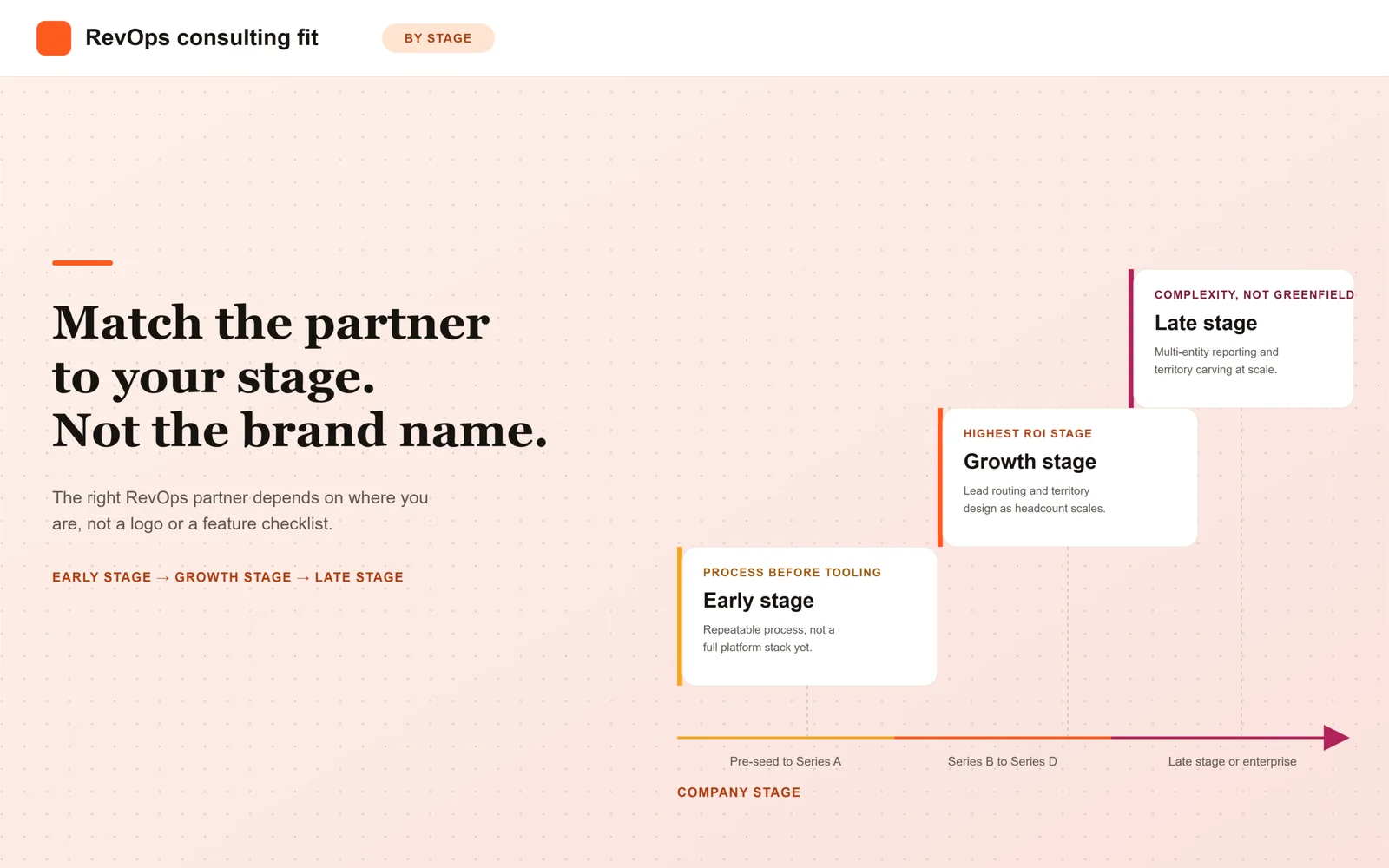
Most comparisons of RevOps consulting services treat every B2B SaaS company as if it needs the same thing. It doesn’t. What a seed-stage company with five reps needs from a RevOps partner looks almost nothing like what a 300-person, multi-product SaaS company needs. The right way to evaluate consulting services isn’t by brand name or feature checklist, it’s by matching the partner’s model to your company’s actual stage of growth.
Why Stage Matters More Than Almost Anything Else
A RevOps consulting engagement that’s perfect for a company doing $2M ARR can be actively wrong for a company doing $20M ARR, and vice versa. Company stage determines:
- How much process needs to exist before tooling makes sense
- Whether you need strategic diagnosis or hands-on execution capacity
- Whether a fractional or project-based model fits better
- How much of the engagement should focus on people/process versus systems
What to Look For by Stage
Early Stage (Pre-Seed to Series A)
At this stage, most companies don’t need a full RevOps build-out, they need someone to help define a repeatable sales process and basic CRM hygiene before scaling spend on tooling. Look for consultants who explicitly say “you might not need everything yet” rather than upselling a full platform stack. The best early-stage engagements are short, focused, and leave you with lightweight, repeatable processes rather than a heavy system.
Growth Stage (Series B to Series D)
This is where dedicated RevOps consulting delivers the most obvious ROI. Pipeline is growing faster than process, sales and marketing are starting to trip over each other, and forecasting needs to hold up for board meetings. Good partners at this stage focus on:
- Lead routing, scoring, and SLA design between marketing and sales
- Territory and comp plan structure as headcount scales
- Forecasting infrastructure that’s accurate enough to bet the business on
Late Stage / Enterprise SaaS
At scale, the problem shifts from “build the process” to “manage complexity across multiple products, regions, and go-to-market motions.” Consultants here need experience with multi-entity reporting, complex territory carving, and change management across large, established teams, not just greenfield process design.
Core Evaluation Criteria That Apply at Every Stage
| Criteria | What to Look For |
|---|---|
| Stage fit | Case studies from companies at a comparable ARR and headcount, not just “SaaS experience” |
| Sales-marketing alignment | Concrete deliverables around shared lead definitions and closed-loop reporting |
| Right-sized scope | Willingness to recommend less, not just sell more services |
| Execution capability | Hands-on CRM/systems expertise, not strategy-only advice |
| Exit plan | Clear plan for handing off ownership to an internal team eventually |
Fractional vs. Project-Based: Which Fits Your Stage?
Early-stage and enterprise companies tend to prefer project-based engagements, a defined problem with a start and end date. Growth-stage companies scaling quickly often get more value from fractional RevOps support, where a consultant effectively acts as an interim RevOps leader across several months while the internal function matures.
Questions That Reveal Whether a Partner Understands Your Stage
- What would you NOT recommend we do right now, given where we are?
- Can you show me an engagement with a company at a similar ARR and headcount to ours?
- How does your approach change for a 20-person sales team versus a 5-person one?
- What does success look like in 90 days versus 12 months?
Frequently asked
How much does RevOps consulting cost?
Pricing typically depends on the engagement model. Project-based engagements are often quoted as a fixed fee for a defined scope, while fractional RevOps support is usually billed monthly, similar to a part-time hire. Expect the price to scale with company stage and the number of systems involved, not just the number of hours.
What is the difference between fractional and project-based RevOps consulting?
A project-based engagement solves one defined problem within a set timeline, then ends. Fractional RevOps means the consultant acts as an interim RevOps leader over several months, staying involved as priorities shift. Growth-stage companies often prefer fractional support because their needs keep changing faster than a single project can capture.
When should a SaaS company hire a RevOps consultant?
The clearest signal is when process gaps start showing up in the numbers: forecasts that don’t hold up, leads that stall between marketing and sales, or reporting that takes days to reconcile. Waiting until Series B or later is common, but even earlier-stage teams benefit from a short engagement that sets up clean CRM habits before scaling.
How is RevOps consulting different from hiring an in-house RevOps person?
An in-house hire owns the function long term and lives inside the company’s day-to-day priorities. A consultant brings pattern recognition from many companies at a similar stage and is often used to build the initial system, then hand it off. Many companies use a consultant first and hire in-house once the role’s scope is clear.
How long does a typical RevOps consulting engagement last?
Early-stage and enterprise engagements are often project-based and run four to twelve weeks. Growth-stage fractional engagements commonly run three to nine months, long enough to build lasting infrastructure, but scoped to end once an internal hire can take over.
What should be included in a RevOps consulting proposal?
Look for a clear problem statement specific to your stage, defined deliverables rather than vague strategy sessions, a stated timeline, and an explicit exit plan for handing ownership back to your team. A proposal that can’t describe what “done” looks like is a warning sign.
Match the Partner to the Problem You Actually Have
The best RevOps consulting relationships aren’t built on the most impressive platform certifications or the biggest brand name, they’re built on a partner who correctly diagnoses what stage you’re at and resists the urge to sell you a bigger engagement than you need. Ask every prospective partner to tell you what they wouldn’t recommend, not just what they would.

CEO & Founder at Revlyn. Part of the team that builds and operates HubSpot portals day to day.