

On this page+
What Is Market Segmentation? (And Why Your GTM Strategy Needs It)
Market segmentation is the process of dividing your total market into smaller groups of prospects who share similar traits, needs, or behaviors, so you can target each group with tailored messaging, pricing, and outreach instead of one generic pitch for everyone. For B2B teams, this usually means grouping companies by industry, size, or buying behavior rather than blasting the same message to every lead in your CRM.
If you’ve ever sent the same cold email to a 5-person startup and a 5,000-person enterprise, you already know why this matters. One of them probably ignored it. Market segmentation is how you stop guessing and start building a go-to-market (GTM) strategy, meaning your overall plan for reaching and winning customers, around who your buyers actually are.
This post breaks down what market segmentation means, the main ways to slice up a market, and why it’s one of the first things you should nail down before you build out sales playbooks or marketing campaigns.
What Is Market Segmentation, Exactly?
At its core, market segmentation is the process of breaking up a large market into smaller groups of customers with similar needs, traits, or ways of behaving. Instead of treating your entire addressable market as one big, undifferentiated blob, you split it into segments that respond similarly to the same offer, message, or price point.
Knowing your segments helps you target your product, sales, and marketing efforts more precisely instead of spreading budget thin across everyone. It’s a simple idea, but most early-stage companies skip it because it feels like a “marketing thing” rather than a revenue thing. Honestly, that’s backwards. Segmentation shapes who your sales team calls, what your website says, and even what features your product team builds next.
The Main Types of Market Segmentation
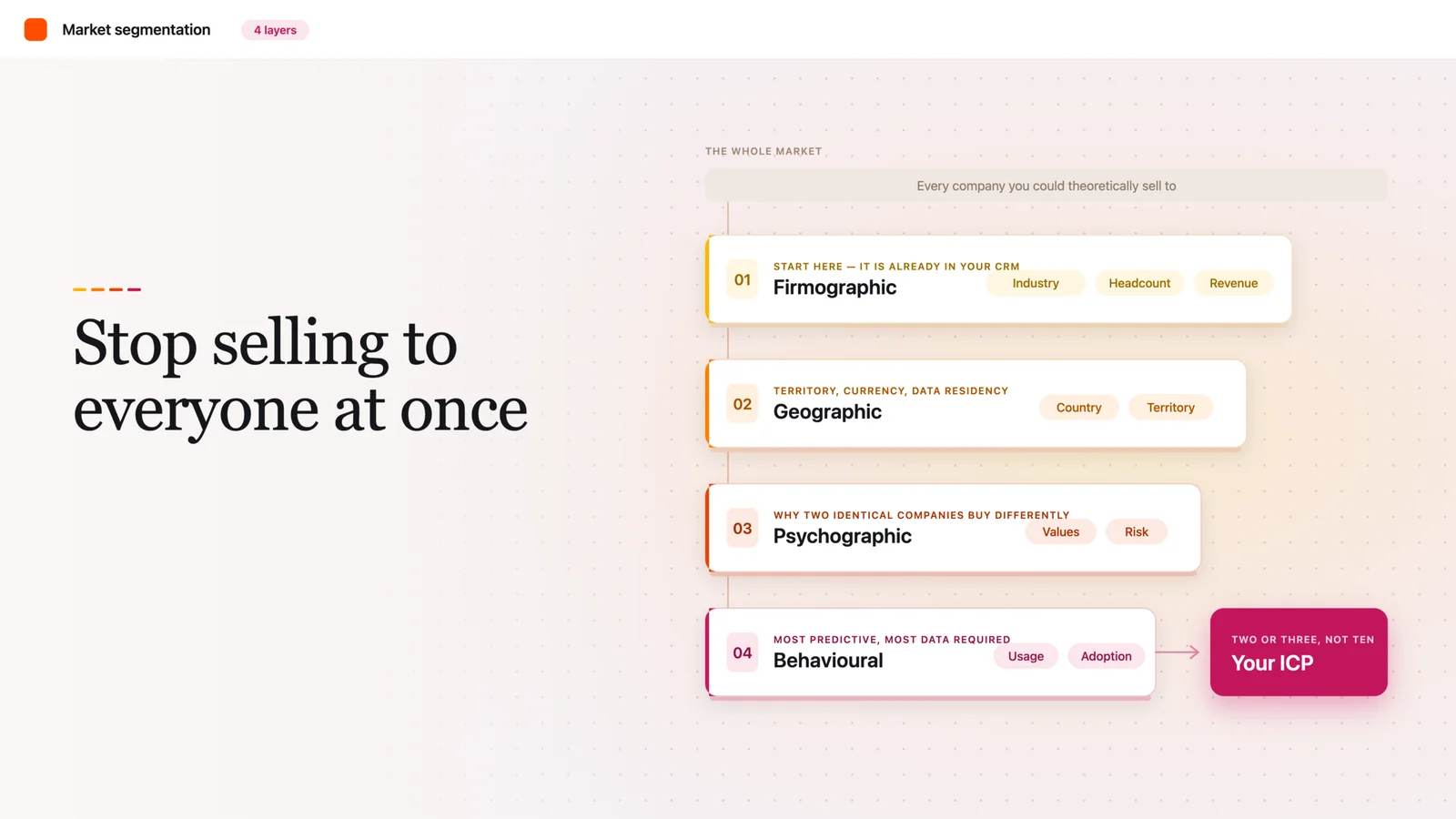
Most frameworks point to four core ways to segment a market: demographic, geographic, psychographic, and behavioral. Each one looks at a different slice of who your buyer is or how they act.
Demographic (or firmographic, for B2B). In consumer markets, this means age, income, or occupation. In B2B, you swap demographics for firmographics: grouping companies by traits such as industry, employee count, annual revenue, growth stage, or technology stack. This is usually the easiest segmentation to start with because the data (company size, industry code, revenue band) is often already sitting in your CRM.
Geographic. This groups customers by where they’re located, since needs and interests often vary according to geographic location, climate, and region. For B2B, this might mean segmenting by country because of data residency laws, currency, or which sales rep owns the territory.
Psychographic. This looks at attitudes, values, priorities, and how a buyer thinks about risk or innovation. It’s harder to measure than firmographics but often explains why two companies of the same size and industry buy completely differently.
Behavioral. This groups people by what they actually do rather than who they are, looking at things like product usage, feature adoption, and the benefits customers seek. In B2B SaaS specifically, the most effective segmentation stacks these layers: firmographic first because it’s easy to identify, then technographic (what tools a prospect already uses), then behavioral, which is the most predictive but needs the most data to pull off well.
Why Market Segmentation Matters for Your GTM Strategy
Here’s the problem with skipping segmentation: your sales team ends up chasing everyone and closing almost no one efficiently. B2B firms have long treated segmentation as a cornerstone of good industrial marketing, and for good reason: success comes from identifying and serving the best-fit prospects for your offering, not everyone who fills out a form.
The data backs this up at the GTM level too. Companies exceeding their revenue targets are 5.3 times more likely to have an advanced go-to-market strategy where the total addressable market is clearly defined and sales and marketing are aligned around it. Separately, companies with a clear GTM strategy have been shown to achieve roughly 30% higher revenue growth and 30% higher profitability than peers without one.
Segmentation is also what makes account-based marketing (ABM), personalized outbound, and even basic lead scoring possible. Without defined segments, your “ideal customer profile” is really just a guess dressed up in a slide deck.
How to Build a Basic Segmentation for Your GTM Plan
You don’t need a data science team to get started. Here’s a simple sequence:
- Pull your firmographic data first. Export what you already have in your CRM: industry, employee count, revenue range, and location for existing customers and closed-lost deals.
- Layer in technographic and behavioral signals. Look at what tools your best customers already use and how they engage with your product or content before buying.
- Group companies into 2-3 high-impact segments. Resist the urge to create ten micro-segments. Focus on two or three segments instead of trying to cover every possible customer type, since more segments than your team can realistically act on just adds noise.
- Write one sentence per segment describing its core need. If you can’t summarize why this group buys in one sentence, the segment probably isn’t well-defined yet.
- Review it quarterly, rebuild it annually. Markets shift, your product evolves, and your customer base changes, so a segmentation model built 18 months ago may no longer reflect reality.
Pro tip: don’t let sales and marketing build separate segmentation models. If your sales team’s territory logic and your marketing team’s audience segments don’t match, your messaging and your pipeline data will quietly drift apart, and nobody will notice until quota season.
Market Segmentation vs. Ideal Customer Profile (ICP)
People mix these up constantly. Segmentation is the broader map of all the meaningful groups in your market. Your ICP is the specific segment (or two) you’ve decided is most worth chasing right now, based on deal size, win rate, or retention. Think of segmentation as the full menu and your ICP as the dish you’re actually ordering.
Frequently asked
What’s the difference between market segmentation and market targeting?
Segmentation is the analysis step: identifying the distinct groups in your market. Targeting is the decision step: choosing which of those groups you’ll actually pursue with dedicated sales and marketing effort.
How many market segments should a B2B company track?
Keep it tight. Most practical guidance points to focusing on two to three high-impact segments rather than spreading resources across every possible customer type.
Is market segmentation still relevant with AI-driven personalization?
Yes, if anything it matters more. AI and predictive models still need a segmentation structure to learn from; they just make it easier to score and prioritize accounts within your defined segments.
How often should we update our segmentation?
Plan on a quick review each quarter and a full rebuild once a year, since customer bases and markets shift faster than most teams expect.
Does segmentation replace the need for an ICP?
No. Segmentation gives you the full picture of your market; your ICP is the specific slice of that picture you’ve chosen to go after first.

CEO & Founder at Revlyn. Part of the team that builds and operates HubSpot portals day to day.