

On this page+
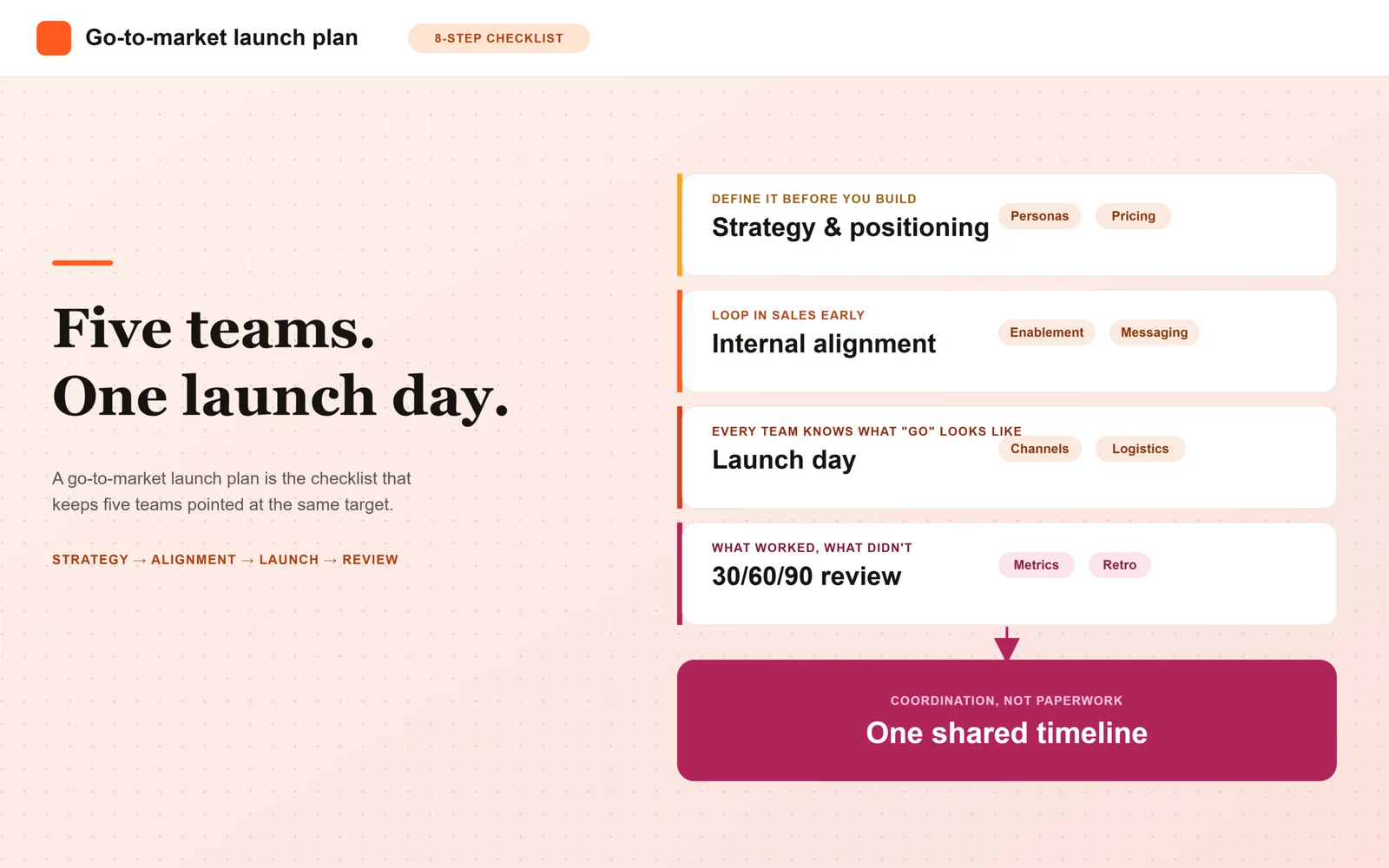
What Is a Go-to-Market Launch Plan? A Beginner’s Checklist
A go-to-market (GTM) launch plan is the detailed roadmap your team follows to introduce a new product, feature, or market to customers. It covers your target audience, positioning, pricing, channels, sales enablement, and launch-day logistics, aligning every team around one shared timeline and goal.
If you’ve ever watched a launch go sideways, sales pushing one message while marketing pushes another, support fielding questions nobody prepped them for, you already know why this document exists. A launch plan isn’t paperwork for its own sake. It’s the thing that keeps five different teams pointed at the same target on the same day.
This post breaks down what actually belongs in a go-to-market launch plan, why skipping it costs you more than it saves, and gives you a checklist you can start filling in today.
What Is a Go-to-Market Launch Plan?
A go-to-market strategy is the broader plan for how your company turns a product into revenue. It’s the thinking behind who you’re selling to and why they’d buy. A go-to-market launch plan is narrower: it’s the operational, dated, task-level version of that strategy for one specific launch event.
One source describes it simply as the planning and preparation for introducing a new product or service to a market, something that puts you in a position to actually reach product-market fit instead of just shipping and hoping. Another way to think about it: a go-to-market strategy is the map, and the launch plan is the turn-by-turn directions with a departure time.
A solid launch plan usually answers these questions before day one:
- Who exactly are we launching to?
- What problem does this solve for them, in their words?
- How is this priced and packaged?
- Which channels will carry the message?
- Is sales actually ready to sell it?
- What happens in the first 30, 60, and 90 days after launch?
If you’re still fuzzy on who your buyer even is, it’s worth backing up to define your ideal customer profile before you build the rest of the plan around a guess.
Why Does a Go-to-Market Launch Plan Matter?
Here’s the problem with launching without one: every team ends up improvising, and improvised launches tend to look inconsistent from the outside. A go-to-market plan is meant to deliver a cohesive customer experience across sales, marketing, and support, rather than a scattered set of one-off efforts that happen to share a launch date.
Without a documented plan, teams tend to drift into their own silos: marketing chases one audience, sales chases another, and product keeps shipping features that don’t map to either. That disconnect doesn’t just look messy internally, it burns through budget and confuses the exact customers you’re trying to win over.
Honestly, most launch failures we see aren’t a product problem. They’re a coordination problem dressed up as a product problem. The features work fine. Nobody agreed on who they were for, or who was supposed to say what to whom, by when.
How Do You Build a Go-to-Market Launch Plan? (Step-by-Step)
Most frameworks converge on a similar sequence, even if the exact number of steps varies by source. Here’s a practical version you can adapt regardless of company size.
-
Define your target market and buyer personas. Get specific about industry, company size, and the roles of the people who’ll actually buy and use the product. Buyer personas are simply a representation of what your ideal buyer looks like, including the roles they hold and the problems they’re trying to solve.
-
Nail your positioning and messaging. What makes this different, and why should a buyer care right now? This is also where understanding your GTM motion (PLG, sales-led, or a hybrid of the two) shapes how that message actually reaches people.
-
Set pricing and packaging. Decide this before launch day, not during a sales call. Pricing decisions ripple into everything from messaging to sales scripts.
-
Choose your channels deliberately. Great launch plans mix channels that work together toward the same goals, dictated by your audience and metrics, rather than trying to be everywhere at once.
-
Get internal alignment first. The launch process touches nearly every team in the company, so it matters that everyone understands the purpose of the launch and their specific role in it before execution starts.
-
Brief and enable sales early. Sales teams need to be briefed well ahead of launch day so they aren’t improvising their pitch in front of a prospect.
-
Plan launch day logistics. Content goes live, campaigns kick off, and every team should know exactly what “go” looks like for their piece of it.
-
Build in a post-launch review. A plan doesn’t end at launch. Post-launch evaluation is part of the process too, so you can see what worked and adjust the next one.
Pro tip: don’t wait until step 6 to loop in sales. Bring them into the room during positioning and messaging (step 2). A rep who helped shape the pitch sells it with a lot more confidence than one who received it as a PDF three days before launch.
Go-to-Market Launch Plan Checklist
Use this as a working list, not a rigid script. Adapt it to your team’s size and launch type.
- [ ] Target market and firmographics defined
- [ ] Buyer personas documented, including roles and pain points
- [ ] Core positioning statement written and agreed on
- [ ] Pricing and packaging finalized
- [ ] Channel mix selected and tied to specific goals
- [ ] Internal alignment meeting held across product, marketing, sales, and support
- [ ] Sales enablement materials built and reps trained
- [ ] Launch day timeline with named owners per task
- [ ] Post-launch metrics defined (what “success” actually looks like)
- [ ] 30/60/90-day review scheduled
One more thing worth knowing: research cited by product marketing teams suggests a typical B2B buying group can include six to ten decision-makers, including influencers and gatekeepers who can slow or block approval. That’s a strong argument for making sure your messaging and sales materials address more than just the person who signed up for the demo.
Frequently asked
Is a go-to-market launch plan the same as a go-to-market strategy?
Not quite. The strategy is the bigger-picture thinking, your target market, positioning, and business case. The launch plan is the execution layer: dates, owners, tasks, and channels for one specific launch.
Who should own the go-to-market launch plan?
It varies by company, but product marketing often drives the document while pulling in sales, customer success, and product leadership as contributors. Someone still needs final ownership, otherwise tasks fall through the cracks between teams.
How far in advance should we start building the plan?
There’s no single universal number, but sales needs to be briefed well before launch day so reps aren’t caught unprepared, which means the plan itself needs to start taking shape weeks earlier than that.
What happens if we skip the launch plan and just wing it?
You can. Plenty of teams do. But without alignment, you tend to get mixed messaging, wasted spend, and a sales team improvising in front of prospects, which is a rough way to find out your pricing page and your sales deck don’t agree with each other.
Does a launch plan work the same way for a small feature update as it does for a brand-new product?
No, scale it down. A feature update might only need messaging, a couple of channels, and a quick sales briefing. A brand-new product or market entry usually needs the full checklist, including deeper buyer research and a longer post-launch review window.

CEO & Founder at Revlyn. Part of the team that builds and operates HubSpot portals day to day.