

On this page+
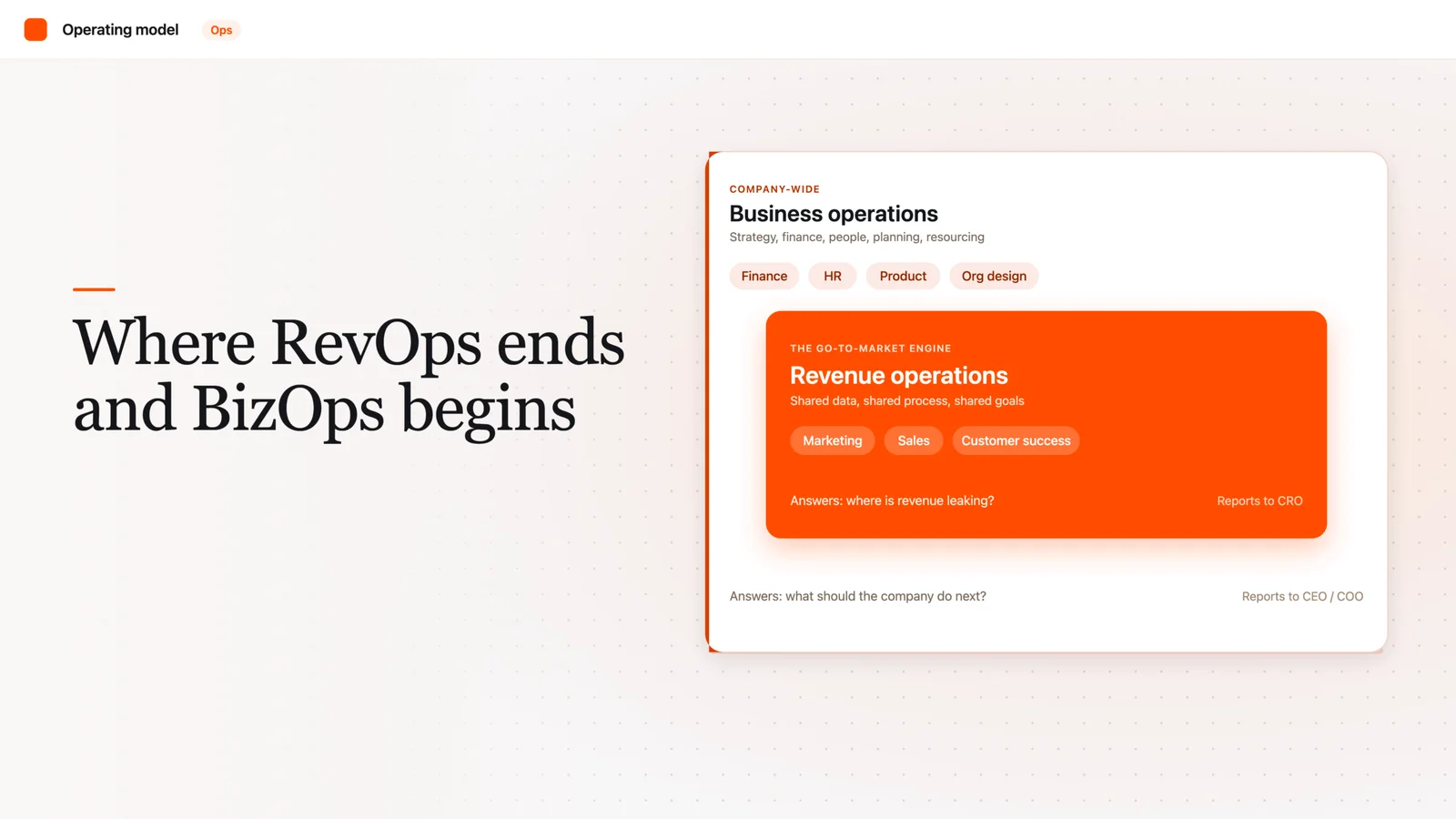
RevOps (Revenue Operations) manages the systems, data, and processes behind your sales, marketing, and customer success teams so they work as one revenue engine. Business Operations (BizOps) is broader: it covers strategy, finance, HR, and execution across the entire company, not just the revenue-generating side.
If you’ve ever sat in a leadership meeting and heard someone say “isn’t that basically the same as ops?” you’re not alone. These two functions get lumped together constantly, and honestly, the confusion is understandable. Both promise to fix inefficiency. Both show up when growth stalls. But they solve different problems, and mixing them up can lead you to hire the wrong person for the wrong job.
What Is RevOps, Exactly?
RevOps stands for Revenue Operations. It’s the function responsible for aligning your sales, marketing, and customer success teams around shared data, shared processes, and shared goals so revenue grows in a predictable way.
Think of RevOps as the team that makes sure a lead moving from a marketing campaign to a sales rep to a customer success manager doesn’t fall through the cracks along the way. Revenue operations is a strategic framework that brings together all revenue-related activities in an organization, unifying marketing, sales, and customer success (and often finance) under one operational umbrella instead of letting each team run its own tools and metrics.
RevOps typically doesn’t touch the day-to-day execution within each department. A RevOps team is usually a strategic function, not one focused on daily firefighting: it builds the systems and reports that let leadership see the whole revenue picture, then gets out of the way so sales, marketing, and CS can execute.
Most companies don’t need a dedicated RevOps hire on day one. RevOps most commonly starts to take shape once a company hits somewhere around the $5 to $10 million ARR mark, when the handoffs between departments start creating real friction.
What Is Business Operations (BizOps)?
Business operations, often shortened to BizOps, is a much wider net. It covers the full set of activities a company uses to turn its people, money, and resources into value: everything from supply chain and HR to marketing execution and financial planning.
Where RevOps lives inside the revenue engine, BizOps sits above it. A BizOps team acts as connective tissue between departments, translating company strategy into execution across finance, product, operations, and yes, sometimes revenue too. BizOps professionals are cross-functional by design, working alongside product, marketing, engineering, sales, and customer success teams to build the systems that keep the whole business running smoothly.
The easiest way to picture it: BizOps owns the connective tissue of the entire company, while RevOps owns the GTM (go-to-market) engine specifically. One is company-wide. The other is revenue-specific.
So What’s Actually Different?
Here’s the plain version:
- Scope. RevOps focuses only on sales, marketing, and customer success. Business consulting or BizOps looks at the entire organization, including finance, HR, and long-term structure.
- Question they answer. BizOps tends to answer “what should the company do next?” (market entry, org design, resourcing). RevOps answers “how is revenue actually generated day to day, and where is it leaking?”
- Where value shows up. RevOps work shows up in pipeline conversion, deal velocity, and churn. BizOps work shows up in strategic decisions, budget allocation, and cross-departmental planning.
- Who they report to. RevOps typically reports to a CRO or VP of Sales. BizOps often reports to the CEO or COO directly.
I’ll say the quiet part out loud: most of the confusion between these two roles isn’t really about job titles. It’s about founders hiring a generalist, calling them “ops,” and hoping they’ll absorb both jobs by osmosis. That works for a while at 10 people. It stops working fast once you’ve got separate sales, marketing, and CS teams that don’t talk to each other.
Why This Distinction Actually Matters
Getting this wrong costs you in a very specific way: you either hire a systems administrator and expect strategic thinking, or you hire a strategist and wonder why your CRM is still a mess.
Organizations that align sales, marketing, and customer success under a coordinated RevOps model tend to see real operational payoff. One widely cited 2020 study found companies could see an increase of up to 20% in sales productivity, a 200% increase in digital marketing ROI, and a 30% reduction in go-to-market expenses after adopting RevOps. Analyst firm Gartner had also projected that by 2025, 75% of the highest-growth companies would run some form of RevOps model, a sign of how mainstream the function has become.
BizOps has its own payoff, just at a different altitude. Because it sits closer to company-wide strategy, its wins tend to show up in things like faster board reporting, cleaner financial planning, and fewer instances of departments (like Finance and Sales) disagreeing on basic numbers like revenue recognition.
A Quick Checklist: Which One Do You Actually Need?
- Are your growing pains specific to sales, marketing, and customer handoffs? That’s a RevOps problem.
- Are they showing up company-wide, like hiring outpacing onboarding or finance and sales disagreeing on numbers? That points to BizOps.
- Are you under roughly $5M ARR? Most founders should own operational thinking themselves before hiring either role.
- Are you between $5M and $10M ARR with a clear GTM structure but messy handoffs? This is usually the right window to hire dedicated RevOps.
- Are you past Series B with a functioning GTM engine but a fraying broader org? That’s typically when BizOps becomes worth building out separately.
Pro tip: if you’re not sure which one you need, look at where the complaints are coming from. If it’s reps complaining about lead handoffs and dashboards that don’t match, that’s RevOps. If it’s your CFO and your head of sales arguing about whose numbers are right, that’s a BizOps conversation.
Can One Person Do Both?
At an early-stage company, yes, and it’s often the most practical path. A RevOps leader who has already mastered cross-functional alignment and systems thinking has a lot of the exact skill set BizOps needs, just applied to a wider canvas. The two disciplines share the same underlying instinct: replace gut-feel decisions with data. Don’t expect that to scale forever, though. Once you’re managing separate GTM and company-wide operating rhythms, splitting the roles usually pays for itself.
Frequently asked
Is RevOps a type of business operations?
You could think of it that way. RevOps is a specialized, narrower slice of business operations that focuses only on the revenue-generating side of the company: sales, marketing, and customer success.
Do small startups need both RevOps and BizOps?
Probably not yet. Most early-stage founders are better off owning operational thinking themselves and adding a dedicated RevOps hire around the $5 to $10 million ARR range, then considering BizOps later as the whole org grows more complex.
Does RevOps replace sales operations?
Not exactly. Sales operations supports the sales team specifically with things like territory mapping and forecasting, while RevOps sits above sales ops, marketing ops, and customer success ops, unifying all three into one coordinated function.
What titles report into RevOps vs BizOps?
RevOps usually reports to a Chief Revenue Officer or VP of Sales. BizOps tends to report to the CEO or COO, since it operates across the whole company rather than just the revenue side.
Which one should I hire first?
If your pain is specifically in how leads move between marketing, sales, and customer success, start with RevOps. If your pain is broader (finance, hiring, cross-department planning), you’re probably looking for a BizOps hire instead.

Part of the Revlyn team that builds and operates HubSpot portals day to day.