

On this page+
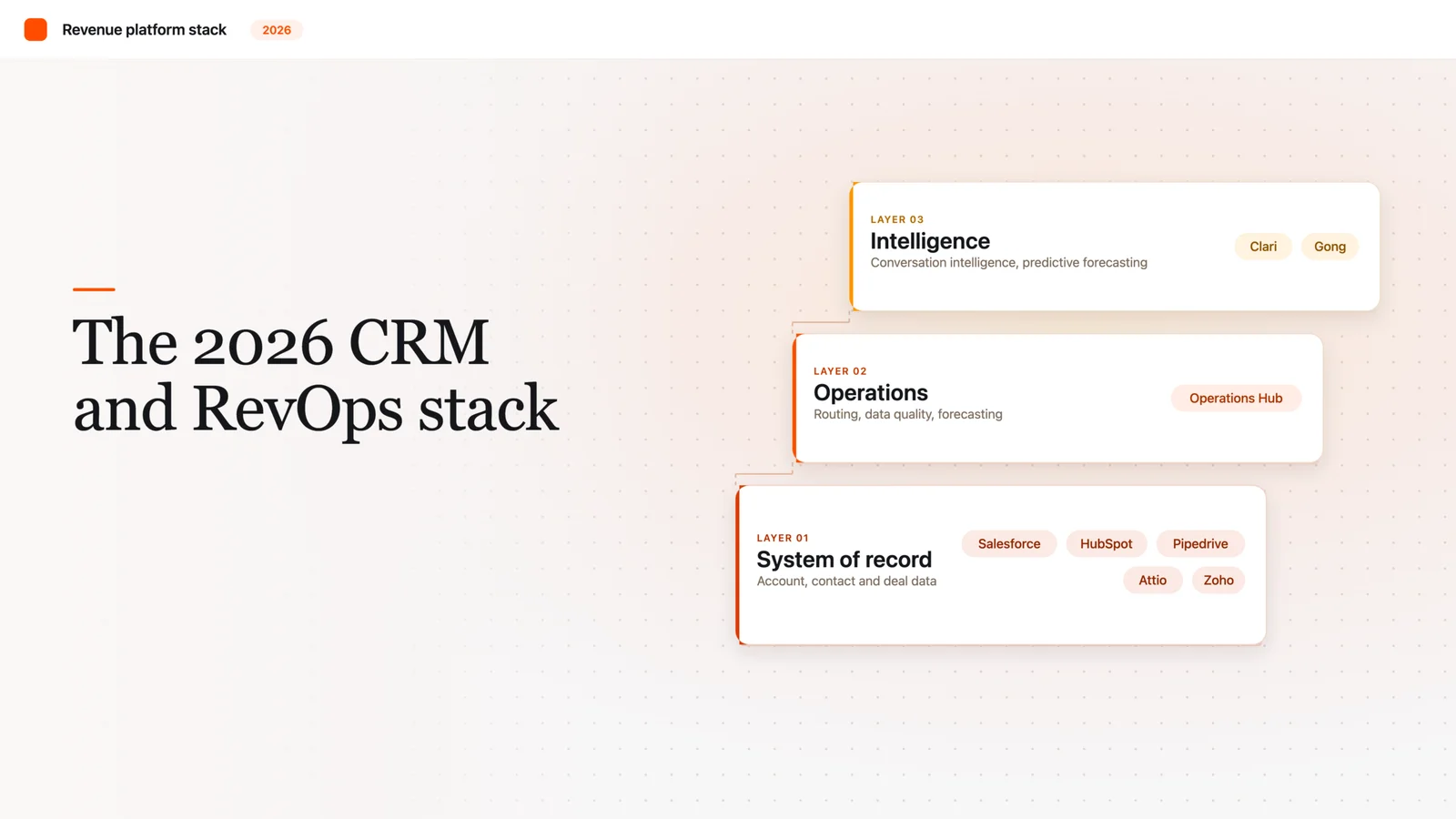
Choosing a CRM used to be a single decision. In 2026, it’s rarely just one platform anymore: most SaaS revenue teams are stitching together a core CRM, a RevOps/operations layer, and one or more AI-driven analytics or forecasting tools. Getting this stack right matters more than ever, because the cost of getting it wrong now compounds across every downstream system it touches.
This guide breaks down the CRM and RevOps platforms SaaS teams are actually standardizing on in 2026, how the category has shifted, and how to match a platform combination to your company’s growth stage.
What Changed in the CRM and RevOps Platform Market for 2026
Three shifts define the current landscape:
- AI moved from add-on to default. Lead scoring, forecast modeling, and deal-risk flagging are now built into core CRM tiers rather than sold as separate modules.
- The “RevOps layer” became its own category. Tools like Clari, Gong, and HubSpot’s Operations Hub now sit on top of or alongside the CRM, handling forecasting, conversation intelligence, and data hygiene as dedicated functions.
- Buyers consolidated vendors. After years of tool sprawl, SaaS RevOps leaders are actively cutting point solutions in favor of platforms that cover more of the revenue workflow natively.
The Three Layers You’re Actually Choosing Between
When people say “CRM platform,” they’re usually describing a stack with three distinct layers:
- System of record: the core CRM (Salesforce, HubSpot, Pipedrive, Attio, Zoho) that stores account, contact, and deal data.
- Operations layer: tools that sit on top to manage routing, data quality, forecasting, and workflow automation.
- Intelligence layer: AI-driven tools for conversation intelligence, signal-based selling, and predictive forecasting.
Most vendors now compete to own more than one layer, which is why platform comparisons have gotten more complex than a simple feature checklist.
Platform Comparison at a Glance
| Platform | Best For | Watch Out For |
|---|---|---|
| Salesforce | Complex, multi-product enterprises needing deep customization | Implementation cost and admin overhead |
| HubSpot | Mid-market SaaS wanting CRM + marketing + ops in one suite | Costs scale quickly as contact volume grows |
| Pipedrive / Attio | Lean sales-led teams wanting speed over depth | Fewer native RevOps and forecasting features |
| Zoho | Cost-conscious teams needing broad functionality | Less polished UX, smaller partner ecosystem |
| Clari / Gong (layered on CRM) | Teams that need forecasting and conversation intelligence, not a CRM replacement | Additional cost and integration overhead |
How to Match a Platform to Your Growth Stage
The right stack depends less on brand reputation and more on where your revenue team actually is:
- Pre-Series A: A lightweight CRM (Pipedrive, Attio, or HubSpot’s free/starter tier) is usually enough. Don’t buy a RevOps layer before you have repeatable process to operationalize.
- Series A to B, scaling GTM: This is where most teams add an operations layer. Lead routing, forecasting, and reporting typically outgrow spreadsheets and native CRM reporting around this stage.
- Series C and beyond: Multi-product, multi-region GTM usually justifies Salesforce’s customization depth, paired with dedicated intelligence-layer tools.
Questions to Ask Before You Commit
- Which layer (system of record, operations, or intelligence) is this actually solving for, and do we already own a tool that covers it?
- What does data migration and integration actually cost, in time and dollars, not just license price?
- Will this platform still fit at 3x our current headcount, or are we buying for today’s team size only?
- Who owns admin and configuration internally, and do they have the bandwidth to maintain it?
The Platform Is Only as Good as the Operating Model Around It
No CRM or RevOps platform fixes misalignment between sales and marketing on its own. It just gives you the infrastructure to enforce alignment once you’ve defined it. The teams getting the most value from their 2026 stack are the ones who nailed process and definitions first, then chose tooling to support it, rather than the reverse.
Frequently asked
What’s the difference between a CRM and a RevOps platform?
A CRM is the system of record: it stores account, contact, and deal data. A RevOps platform (or RevOps layer) sits on top of or alongside the CRM to handle lead routing, forecasting, reporting, and data hygiene across sales, marketing, and customer success. Many teams need both, not one instead of the other.
Do I need a separate RevOps layer if I already have a CRM?
Not always. Early-stage teams with simple, low-volume pipelines can often rely on native CRM reporting and manual process. A dedicated RevOps layer typically becomes worth the investment once lead volume, headcount, or reporting complexity outgrows what the CRM handles natively, usually around Series A to B.
Which CRM is best for early-stage SaaS companies?
Lightweight, fast-to-implement tools like Pipedrive, Attio, or HubSpot’s starter tier are usually the right fit pre-Series A. The priority at this stage is speed and low overhead, not deep customization or a full RevOps layer.
How much does implementing a RevOps stack typically cost?
Costs vary widely based on team size, data volume, and how many systems need to integrate, but license price is rarely the biggest cost. Implementation time, data migration, and ongoing admin work usually add up to more than the subscription fee itself, which is why total cost of ownership matters more than sticker price when comparing platforms.
When should a SaaS company move from HubSpot to Salesforce?
This shift usually makes sense when a company moves into multi-product or multi-region go-to-market motions that require deeper customization than HubSpot supports, or when contact volume growth makes HubSpot’s pricing model less cost-effective than Salesforce’s structure. It’s rarely worth making the switch before that complexity actually exists.
What’s the biggest mistake SaaS teams make when choosing a CRM or RevOps stack?
Buying tooling before defining process. A platform can’t fix misaligned sales and marketing definitions or an undefined lead lifecycle on its own. Teams that get the most value from their stack define their process and shared definitions first, then choose tools to support it, rather than expecting the software to create alignment for them.

CEO & Founder at Revlyn. Part of the team that builds and operates HubSpot portals day to day.